

AI-assisted: the argument and direction are mine. I used AI to edit the prose.
Within three weeks this fall, two companies shipped very different things that share a pattern. My argument is that AI products are heading toward a split: a small model decides, a large model writes, a generated screen appears only when it helps, and plain code governs the handoffs between them. On September 15, TypeSafe AI came out of stealth with Jev, a model that does not write text at all. It takes some state and a set of questions and returns typed answers with probabilities attached. On October 7, OpenAI launched Intelligent UI in ChatGPT, where the model assembles an interactive screen from a fixed library of components while a compiler renders it as the answer streams in.
Each model is limited in what it may output. Jev can only pick from the options you declared. Intelligent UI can only choose from components that already exist. These are different kinds of bounded output, since Jev selects an answer while Intelligent UI composes from parts. In both cases a model’s judgment is squeezed into a closed vocabulary, and ordinary code does everything around it.
I think that is the shape of where AI-based development is heading, and this post argues it with one made-up app. A caution first. These are two data points from two vendors, and in what I read, neither company frames its launch this way. Jev is in early access with no independent evaluations, and Intelligent UI is a ChatGPT feature, not something you can embed. Treat this as a reading of the direction, not a settled trend. The timing is also not the main reason it matters now. The need was already there.
The need was always there
Software has always had questions like these. Take a log parser that receives payloads from systems it doesn’t control. The field that should say “error” arrives as “ERR”, “Error:”, “fatal”, or something nobody has seen before. Today that code carries a hardcoded list, a few regular expressions, and a fuzzy match someone tuned years ago. It works until a new value shows up.
A large language model would handle it well, but a call per record is too slow and too expensive. A trained classifier would handle it too, but only after someone labels data, trains it, and takes ownership of one more model per problem. So teams kept the regex. What was missing was a cheap, fast, general way to ask a fixed-answer question about messy input. That is the job of what you could call a decision model: a model whose only output is a choice or a score with a probability, not prose.
Cost and latency are the hook. Send a request to a large model and you wait seconds and pay for every word it reads and writes. A decision model returns in a fraction of that time and, if the vendor’s numbers hold, at a fraction of the price. The rest of this post takes one request apart to show where each kind of model belongs.
One sentence, four jobs
It’s some Friday night not far from now. The game is on, three friends are on your couch, a few more are twenty minutes away, and nobody wants to be the one who gets up and orders.
So you shout across the room to your favorite assistant. It’s hooked up to a pizza app called SliceWise, which is fictional, of course, but hey, what if. You say: “Same as last time but spicy, a few more friends are coming, and no pineapple please.”
One friend groans at the pineapple line. Any friend in the room gets the gist, even if nobody is sure how many are coming. The app, on the other hand, has about two seconds to turn it into an order before somebody gets up and orders the old way.
The first version sends the whole sentence to the largest model the team can afford. The demo works. Then traffic arrives: every order waits several seconds, the bill grows with every request, and once in a while the model reads “no pineapple” as a preference when the customer meant an allergy. The model isn’t broken. The team asked one system to do four jobs and gave it no way to say which it was unsure about.
The four jobs are these: decide what the request means, write the reply, show a screen when words aren’t enough, and govern what happens when the system is unsure. Each one wants a different tool.
The four stages
Here is the design as a system. A request comes in as messy input. A decision stage turns it into typed answers with probabilities. A writing stage produces the words, a showing stage produces a screen only when one helps, and a governing layer of plain code reads the probabilities and decides what happens next. The sections below take them in order.
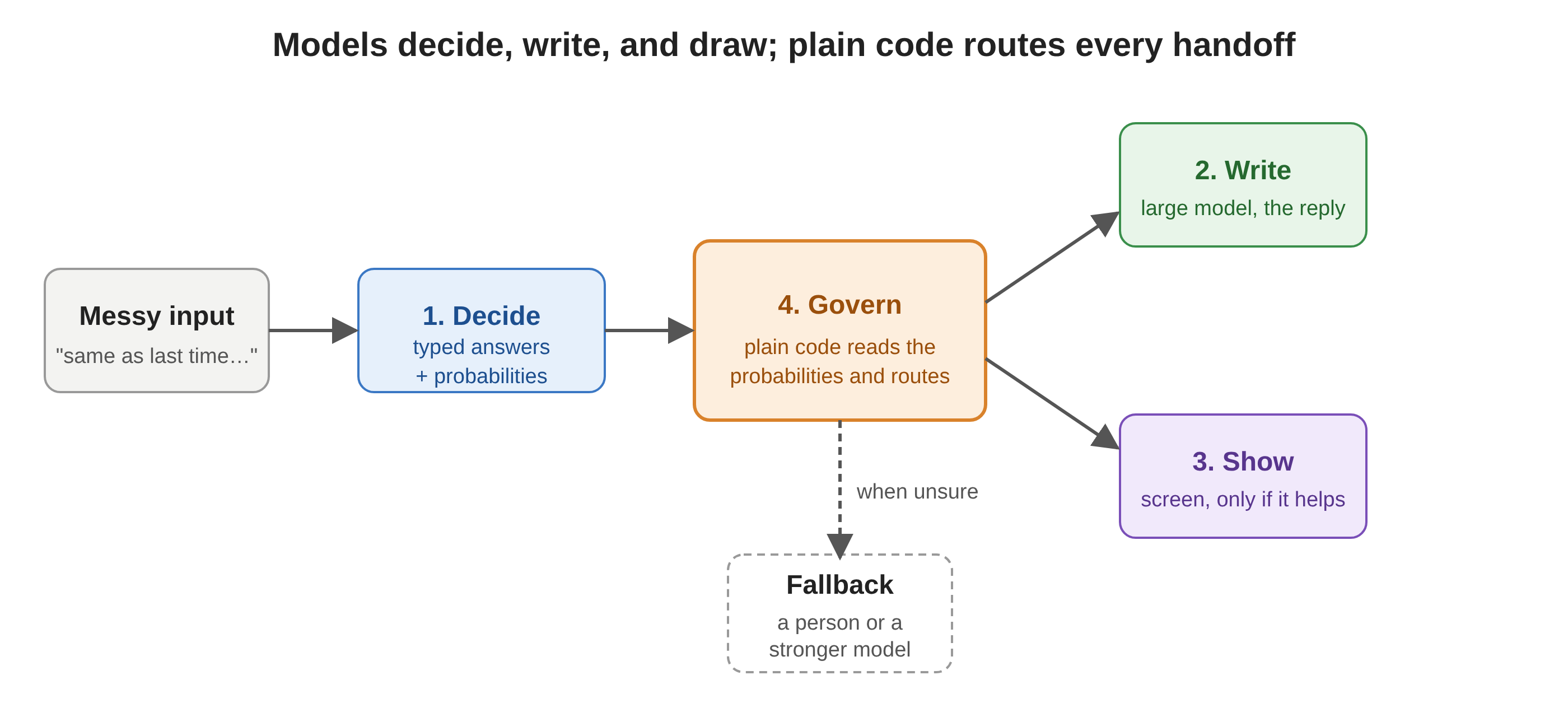
A request moves left to right through the decision stage into plain code, which routes it to the writing model, a generated screen, or a fallback when confidence is low.
1. Decide
Look at the sentence again and list what the app needs to know before it can act. Is this a reorder, a modification, or a complaint? Could “no pineapple” be an allergy? Does “a few more friends are coming” change the headcount, and by how much? Each is a small decision with a fixed set of answers, and the useful output is a confidence number that code can act on.
This is Jev’s job. TypeSafe calls it a System One model, borrowing Kahneman’s term for fast, intuitive thinking. You hand it state, such as a JSON object or a plain sentence, along with questions you define in natural language. It returns choices, scores, or yes/no answers with probabilities, evaluated in one parallel pass instead of token by token. TypeSafe lists response times of 70 to 500 milliseconds and a price of $0.042 per million input tokens, with output free.
Those numbers come from the vendor. At launch there were no independent evaluations, no weights, and no paper detailed enough to reproduce the work, and on its own benchmark dashboard Jev trailed the best comparator in aggregate. Classifiers of this shape are not new either. GLiNER and a 2024 classifier from Answer.AI covered similar ground. What looks new is the combination: frontier-scale training, questions defined at call time, calibrated probabilities, and a price that lets you put the call inside a loop that runs a million times a day.
Which calls belong here? A call is a good candidate when most of these hold:
The answer comes from a closed set. Jev caps a single choice at 255 options,.
Your code branches on the result, so a probability is more useful than a paragraph.
The call is frequent, sits in a hot loop, or has a person waiting on it.
A wrong answer is cheap, or a fallback or a human catches it.
Nobody needs the model to explain itself, since this kind of model returns numbers, not reasons.
The input fits comfortably. Context windows are limited, so check the cap.
Calls that fail most of these should stay with a chat model: open-ended writing, multi-step reasoning, anything that needs an audit trail in words.
Frequency cuts both ways. Every call still hits a hosted model and bills input tokens, including the questions you send along with the data. At the listed price, a million decisions a day at 500 tokens each comes to about $21 a day, which is small until the volume or the payload grows. So treat a decision model as one layer in a cascade, not the front door. Exact matches, caches, and rules you trust go first. The decision model takes what they can’t resolve, and a stronger model or a person takes the low-confidence band.
2. Write
Once the decisions are made, what’s left for the big model is the part it is good at. It answers the room in a voice that sounds like a person. It confirms the order, mentions the extra heat, and teases the friend who groaned about pineapple. This is the work language models are good at, and the only place in SliceWise where a bigger, slower, pricier model is worth what it costs.
The model stops being the product and becomes one component in it. It gets called less often, with a narrower job, and with the decisions already made for it. The reply may also improve, because the model is told what was decided instead of having to infer it while also trying to be charming.
3. Show
Now the screen. You said a few more friends are coming, and the app can’t tell whether that means four people or eight. A headcount slider appears on your phone as the assistant asks the question aloud. If the sentence had said “for six,” it wouldn’t have.
OpenAI brought this idea to a mass audience on October 7, 2026, with what it calls Intelligent UI alongside GPT-6 in ChatGPT. Answers can include interactive charts, forms, calculators, and buttons chosen to fit the question. Adaptive interfaces existed before, including templates composed at runtime and interactive outputs in other chat products, so the idea itself is not new. What OpenAI describes as different is the construction: a library of native components, and a compiler that processes the interface while the model is still generating it, so the screen builds up progressively. OpenAI presented it as a ChatGPT capability, and in launch week I could find no announcement of an embeddable version for developers.
Pay attention to what the model is deciding here. It isn’t painting pixels. It is choosing from a fixed set of components and filling in their parameters. That is bounded, but it is not the same kind of decision as Jev’s. The model has real freedom over layout and interaction, and the constraint is on the form of its output. The hard part comes after the tap. When the customer drags the slider to eight, something has to validate that number, update the order, and cope with a change of mind. Andrew Chen made the same observation about generative UI in general: generating the interface is not where the difficulty lies.
4. Govern
The harness is the code around the models. It is the least exciting part of SliceWise and the part that decides what kind of product it is.
Here is what it does with your order. When a decision comes back above 0.95, the app acts without asking. Between 0.6 and 0.95, it asks one clarifying question and uses the answer. Below 0.6, a person at the restaurant takes over. And if the allergen question returns anything above a very low threshold, the app confirms out loud, however sure it is about everything else.
Imagine two teams building the same app on identical models. One sets the thresholds at 0.7 and 0.4 and never writes the allergen rule. Their app feels fast, and occasionally it sends a nut-free customer something they shouldn’t eat. The other sets 0.95 and 0.6, adds the allergen rule, logs every low-confidence case, and reviews the log each week. In this made-up case, I’d expect customers to call the first app slick until the first bad order, and the second trustworthy from the start.
The models were identical. The difference came from people deciding what the app should do when it isn’t sure, and writing that down as code that can be tested, versioned, and argued about in a review. A decision model helps because it hands back the uncertainty as a number. A chat model that answers “Sure, I’ll take care of that!” gives the code nothing to branch on.
One caution about those numbers. They are illustrative, and a probability only means something once you have checked it against outcomes on representative data. Even then, the probability that the model read the request correctly is not the cost of acting on a wrong reading. A 90% score may be fine for suggesting a topping and unacceptable for interpreting an allergy. So the real abstraction is a decision policy that weighs confidence, the cost of a mistake, and whether the action can be undone, which is why the allergen rule sits outside the thresholds.
A decision model also fails quietly, so plan for drift. Inputs change, the meaning of a label shifts, and the model can change underneath you. Jev’s early-access alias is jev-latest, so ask early whether versions can be pinned.
To catch it, log every decision with its input, probabilities, model version, and the action your code took. Then watch the share of decisions in each confidence band, since a growing middle band is usually the earliest warning. Check calibration on a small labeled sample each week, count inputs unlike anything you’ve seen, and rerun a frozen golden set on a schedule and whenever the model version changes.
To resolve it, start with the cheap levers: move a threshold, tighten the wording of a question, or send the uncertain band to a stronger model or a person. A self-improving loop is worth planning, but a gated one. Low-confidence cases get labeled by a stronger model or a human, those labels grow your evaluation set first, and no change ships until it passes against the frozen set. Keep humans on the rules that guard against real harm, such as the allergen check.
Won’t one capable model do all of this?
There is an obvious objection. Frontier models keep getting faster, cheaper, and better at reasoning, so maybe splitting the work into decide, write, show, and govern is a temporary compromise. A future model could read the order, call the tools, build the screen, and follow the policies in one pass.
That is plausible, and for a low-volume app one capable model may already be the right tradeoff. Specialization has costs of its own. Extra calls add latency, a mistake in the decision stage can carry into every stage after it, and several models and policies are more to maintain. A large model may also read a situation correctly that a narrowly framed classifier gets wrong. Nothing says four small components beat one large model.
Some of the split will disappear for that reason. The part driven by latency and cost, which is the case for using a cheap model on a one-word answer, gets weaker as general models get cheaper and faster.
The part driven by authority is harder to dissolve. Suppose a model became extraordinarily good at reasoning about payments. You would still want authentication, spending limits, policy checks, audit logs, and a way to reverse or dispute a charge, and you would want them outside the model’s own response. Those boundaries exist for accountability, not because the model lacks intelligence.
So the lasting idea may not be many specialized models. It may be intelligence with explicit limits on what it is allowed to do, with ordinary code holding those limits. Whether you use one model or four, someone has to decide where interpreting a request ends and acting on it begins.
Friday night, again
You say the same thing a week later. The reorder decision comes back at 0.97. The allergen question comes back low. The headcount question comes back at 0.62, split between four and eight, and the harness does what it was written to do.
The assistant asks out loud, and a slider lights up on your phone: “Is this for four people or eight?” You drag it to eight. The app adds two more pizzas, keeps the jalapeños, leaves off the pineapple, then reads back the total and a delivery estimate and waits for your yes. Only after you confirm does anything get ordered.
The whole exchange took about as long as saying the sentence. You never saw the four jobs, the thresholds, or the compiler. You saw an app that seemed to understand you and asked one good question at the right moment. Placing the order was your decision, not a model’s.
What to try first
If you build on language models, the useful question is less which model is smartest and more which jobs in your flow are decisions, which are writing, and which are screens, and who owns the rules for when the model is unsure. You don’t need any particular model to start.
List every model call in your flow and mark whether it returns free text or a closed set. Many calls that return a single word are decisions in disguise, and so are the regexes and hardcoded lists that guess at values you don’t control.
Put each candidate behind a small interface that returns a choice or a score with a probability, so the model stays swappable in a category this new.
Run the candidate in shadow mode beside the current path and log both answers.
Build an evaluation set from the disagreements and from outcomes you already know. Measure accuracy, whether a 0.9 is right about nine times in ten, latency, and cost on your own data, not the vendor’s.
Set thresholds and fallbacks from that evidence, then move traffic gradually.
For every consequential action a model can trigger, ask who decides whether the model is allowed to be wrong. If the answer is another prompt telling it to be careful, there is more engineering to do.
Whether Jev fits your workload is something only your data can settle, and the method is the same if you try an open classifier or a small chat model constrained to a fixed set of answers. As far as I know, nobody has built SliceWise yet. The pieces are on the table now, and the harness is the one you can start on without waiting for anyone.
Sources
Introducing System One Models & Jev, TypeSafe AI, September 2026
GPT-6 for everyone, OpenAI, October 7, 2026
OpenAI Rolls Out GPT-6 and Intelligent UI in ChatGPT, Let’s Data Science
OpenAI launches Intelligent UI in ChatGPT, RuntimeWire (source for the component library and compiler description)